
It's not the phone. It's never been the phone.
Michel Heitzmann

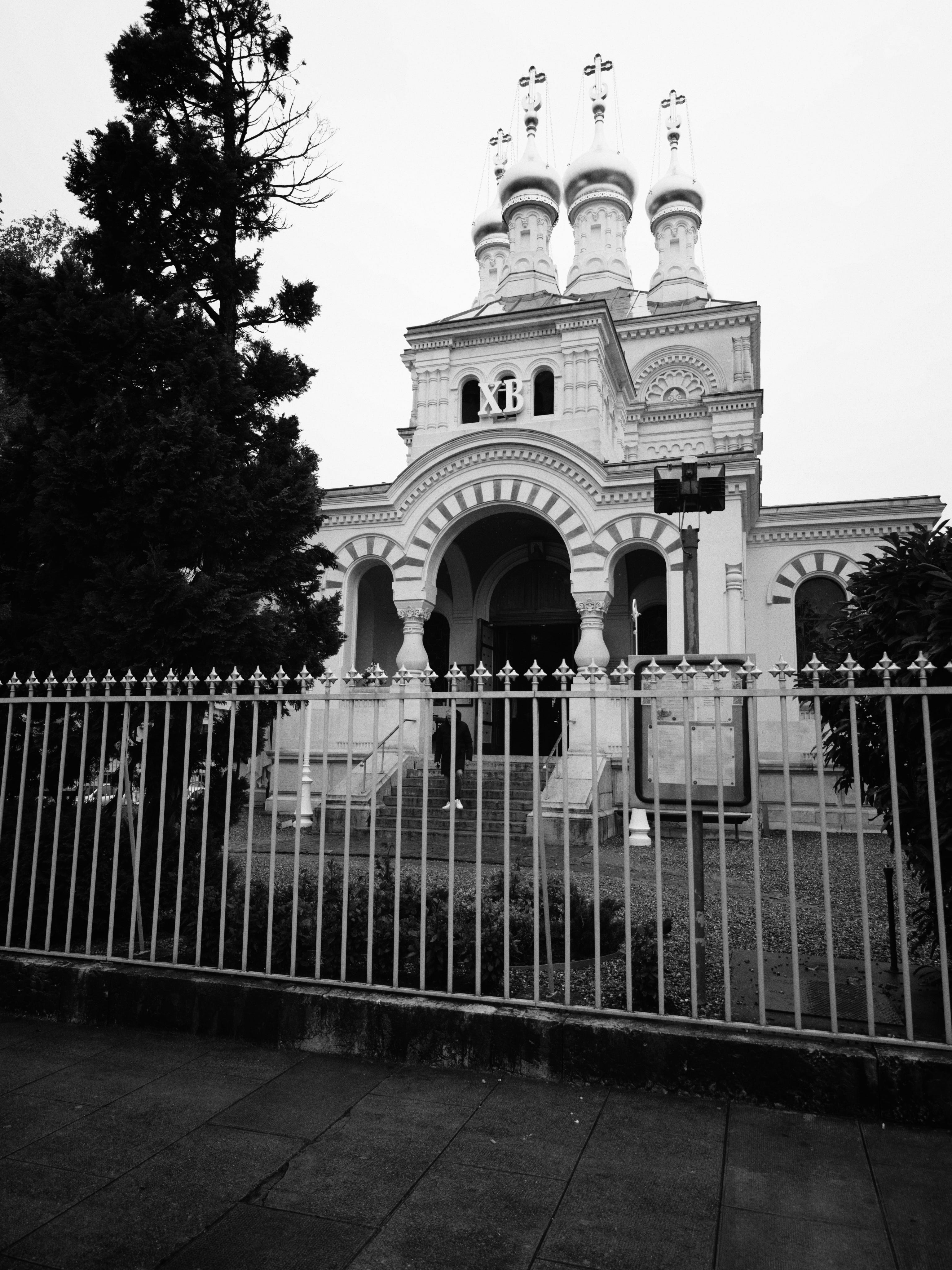
© Michel Heitzmann - Where I first met God, Geneva
Last week I told you what I believe in. Liberal. Humanist. Eco. No hesitation, no apology.
This week is why that matters.
Liberalism, in its actual meaning, and not the Republican insult, is the belief that a person can think for themselves. That the individual has the capacity, and the right, to reason freely. It sounds obvious. It is, in practice, almost never allowed. Not through chains. Through stories and belonging.
I know this because for most of my life, I was not thinking. I was performing. Exceptionally well.
I was maybe six years old in Buenos Aires. Orthodox church. Every Sunday. Standing, always standing. Yellow velvet robe on, serving mass, because that is what good boys from good families wore on Sunday mornings. Candles lit everywhere. The building packed with older folks. Thirty-something degrees (Celsius, close to 100 for those across the big, beautiful ocean) outside, considerably more inside. Nobody asked if I wanted to be there. Nobody needed to ask. This is what I must do. This is who we are.
I didn’t believe a word of it. I didn’t even understand the old slavonic gibberish. I’m not sure anyone asked me if I did. I was not thinking. I was standing in yellow velvet in thirty-degree heat, being a good boy.
Then we moved to São Paulo and the city got in the way. The church was far. Traffic was bad. My parents had golf on Sunday afternoon. Conveniently my step-dad was Catholic, so we switched to a different ritual.
Cooler building, seats, comfortable clothes, shorter affair. My struggle shifted from not fainting to fully understanding the words but not falling asleep during the homily: I memorized the mass anyway. Cordeiro de Deus que tirais o pecado do mundo. Every response, every ritual beat, every gesture. I was excellent at church.
Then, as a teenager, we stopped going altogether. The priests were pushing the theology of liberation. They were, it should be noted, following a tradition that Church had perfected over centuries: taking land from others in the name of something higher. This time the target was the big landowners (who accused the Church in turn that itself was a huge landowner and should accommodate settlers.) Redistribution in the name of God. My parents were not amused. It turned out the story was good as long as it pointed in the right way.
Nowadays the evangelists down south figured it out. Brilliant, really. Give hope to the “oppressed.” Speak their language, move into their neighbourhoods, fill the room with music and feeling and the certainty that Jesus sees them. And while you’re at it, keep them exactly where they are, skim ten percent of what they don’t have, and build a tax-free enterprise worth billions on the distance between the promise and the delivery. The Church had spent centuries taking land. The evangelists found something more efficient. They took votes and the future. And the whole Brazilian football who stopped winning.
The Russian Orthodox Church? Let me not go into smuggling and war for now.
At some point I did the math. Stories written hundreds, sometimes thousands of years ago. Meanwhile man orbits the moon. Give me a break.
That was a partial awakening. Convenient. Not dramatic. Not rebellious. Just a quiet moment of noticing the costume and the theater.
Marx called religion the opium of the people. He wasn’t wrong, but he was too economic about it. Religion isn’t just an anesthetic. It is a narrative architecture. It gives you a story in which your suffering has meaning, your compliance is virtue, your reward is deferred but guaranteed, or so we have been told. You don’t need a prison if the prisoner believes the cell is sacred. You dress a six-year-old in yellow velvet, put him in a hot decorated room, and let the ritual do the work. The brilliant part is that it doesn’t feel like control. It feels like belonging.
School works the same way. Education largely teaches alignment. The grade doesn’t measure intelligence. It measures compliance with the expected answer, delivered in the expected standard, by the expected deadline. Diverge and you are difficult or, nowadays have ADHD. Excel within the parameters and you are gifted. The system rewards its own confirmation.
I was good at school. Genuinely good. I did what was asked. I internalized the rules so thoroughly I stopped noticing they were rules. Still not thinking. Still performing.
There was one exception. On Saturday afternoon, while my friends played football outside in the South American heat, I was sitting in a classroom learning Russian. Russian. I was at the end of the world, literally the southern tip of the Americas, and someone had decided that what I urgently needed was the language of people who lived eleven time zones away, bad people that had taken all possessions from the glorious family I belonged to, in a country I could not find a single reason to care about.
Those communists were so far away they barely felt real. The indoctrination was running at full speed anyway. Language as identity, identity as loyalty, loyalty as the pride of older generations. I responded with the only weapon available to a child in a good family who cannot actually leave: complete and deliberate incompetence. I made no effort whatsoever. Zero. I was spectacularly, almost artistically bad at Russian. It was my one act of resistance against a system that had otherwise installed itself in me without a whisper of friction.
Decades later, I was posted to Russia for six years.
The universe has a very long memory and absolutely no sense of mercy.
I was four years in Argentina. Around twelve in Brazil. Six years in Russia as an adult. These were not boring political moments. Argentina and Brazil were living through regimes that had strong opinions about what citizens should think, say, and aspire to. Russia was, well, Russia. A country that has never really lost the habit of having strong opinions about those things.
Here is what I remember from all three: I was thriving.
Good grades. Good behavior. Good family. Polite. Punctual. Compliant in ways I didn’t even recognize as compliance, because I’d never tried anything else. Not thinking. Thriving.
My story is not survival. It is successful performance.
The ones who are obviously coerced get our sympathy. We make films about them. The ones who are successfully shaped never notice. They get promoted. They get applauded. They grow up and wonder much later whose definition of success they were optimizing for. I was the model child of models I had never chosen. I was winning a game whose rules I hadn’t read. I didn’t need to read them. I had a yellow velvet costume and decent manners.
Open repression is easy to recognize. Censorship. Disappeared journalists. The list of things you cannot say. It hurts visibly, which is its only disadvantage as a control mechanism. You know it’s there. The western version is subtler and, in many ways, more elegant. It doesn’t remove information.
We drown in it. It doesn’t silence you. It gives you CNN and Fox News simultaneously and lets the resulting noise do the work. Both channels running with captions in airport departure lounges across the world, neither one capable of letting a sentence finish before the chyron announces the next emergency. You don’t need to suppress the truth. You just need to make it impossible to concentrate long enough to find it. Right, Mr President?
Then came Cambridge Analytica, and we learned the game had been upgraded again. It wasn’t enough to flood the zone with noise. Now the noise could be made for you. Your feed, curated by an algorithm that had been studying you longer than your mirror, showing you exactly the content most likely to confirm what you already believed, harden what you already feared, and keep you scrolling for eleven more minutes. Democracy-flavoured. Self-administered. Outrage and attention as a subscription service you never signed up for and can’t cancel. The scandal broke in 2018. Everyone was shocked. Then everyone kept scrolling. Not thinking. Scrolling.
I deleted my accounts. Felt rather good about it. Told a few people. Nodded seriously at the dinner table about data sovereignty and consent.
Nonetheless, I gave up on the illusion of being freed up when a Swisscom agent told me what the password of my home network was. Ok, am being watched, later confirmed by a former NSC contractor exiled somewhere in Russia.
I kept performing in every other system without changing a single thing. Different stage. A disguise. Still not thinking.
Before Christmas was a holiday, it was a riot.

© Michel Heitzmann - Christmas tree, Sagrada Família, Barcelona
For centuries across Europe, the winter solstice period meant something quite specific. The poor went to the houses of the wealthy, made noise, demanded food and drink, and expected to receive them. It was called wassailing, or mumming, or simply the way December worked. It wasn’t charitable. It wasn’t sentimental. It was a social contract enforced by the implicit threat of a crowd outside your door on a cold night. The well-off paid, the poor ate, and everyone understood the arrangement.
This unpleasant pagan folklore made it to America too with the riff-raff that arrived.
Then in 1823, a poet named Clement Clarke Moore, or possibly a man named Henry Livingston Jr., published a poem either one wrote for their kids.
The poem is about a jolly, fat and white bearded man in a red suit held together by a big black belt who came down your chimney and left gifts for your children while everyone slept peacefully. No crowd outside. No negotiation. No transaction at the door. Just a warm, private, family scene with presents underneath a tree.
Within two generations it was ancient tradition. Within four it was a global economic bonanza, fueled by Coke jingles and ads, worth hundreds of billions of dollars annually. The rowdy collective ritual became a lovely family moment. The demand became a wish. The crowd became a child’s letter to the North Pole. Ding, went the cash registers.
A story doesn’t need centuries to become the truth. It just needs repetition and emotional resonance. Give it a child’s imagination and a family’s ritual and it becomes the way things have always been. Nobody designed this transformation in a boardroom (well, perhaps at Macy’s, they did.) It simply became too useful to question. For department stores, for governments, for anyone who preferred people spending quietly indoors to people rioting loudly outside.
And now? Apology to leaders, consultants and change managers but corporate culture works on the same principle, just with worse catering.
Culture fit is the polite term for your compatibility to the system. Onboarding is initiation. Please find attached and hope this finds you well are submission rituals. A social contract written by no one, enforced by everyone, where deviation reads as aggression or incompetence. Documented in annual performance reviews, ranked and stacked to determine your future compensation or if you deserve the door.
You perform these things voluntarily because the cost of not performing them is invisibility or exile. Being worse off.
You contribute to it actively as you go up the ladder. No conspiracy required. No room full of people designing it. Compliance is useful to institutions, to markets, to anyone who benefits from predictable people, a.k.a. team players. The system selects for it naturally, the way rain water finds the gutter.
And Steve said some seventeen years ago that you just needed your finger.
Steve’s phone and Eric’s copycats made the latest version of a very old operating system much better.
The upgrade nobody voted for and everybody installed. What it did was remove the friction. The church requires Sunday mornings. The school requires attendance. The corporation requires office hours (until COVID hit but now it is back on.) The phone requires nothing. It’s always on, always available, always offering the next thing to react to, always making you feel slightly behind. Claude is brilliant (used to be chatGPT until a war department overstepped) and TikTok is great, aren’t they?
You carry the compliance architecture in your pocket and you call it a lifestyle or belonging. Look at my new orange phone.
The genius of this version is that it feels like freedom. You choose to download the app. You choose to follow the account. You choose to scroll. Nobody dressed you in yellow velvet. You dressed yourself. You even paid for the phone. Sometimes dearly. You choose it all.
Or you think you choose. Elon, Sam, Mark, Tim and Dario might cherish your naivety.
The liberal promise is autonomy. The reality is that autonomy requires constant active defence. It doesn’t come pre-installed. Every generation has to fight for it against structures that benefit enormously from predictable, manageable, quietly compliant us.
I was a good boy. Excellent at church, excellent at school, thriving in countries with firm views on what thriving should look like, fluent in every corporate ritual I ever encountered. It took me an embarrassingly long time to ask who wrote the liturgy and if I had to comply.
Meanwhile, while we are perfecting our submission rituals and liking each other’s posts, something else is happening.
Species are disappearing. Forests are going. Reefs are turning white. Eight billion people, about 70% of them holding a device engineered to keep their attention moving in small fast circles, and the thing that actually needs watching is everywhere around them. Not behind a screen. Just outside the window.
I was not thinking. Perhaps I am starting now.
Are you thinking?
I built The Quiet Frame to help us reconnect with ourselves, others and the planet. Not sure am doing a good job but at least I have a go. If you are curious, go to thequietframe.com/app, download it, yes ironically, to your smartphone, and let me know what you think.
Thanks for reading.