
Ze Saucisson
Michel Heitzmann

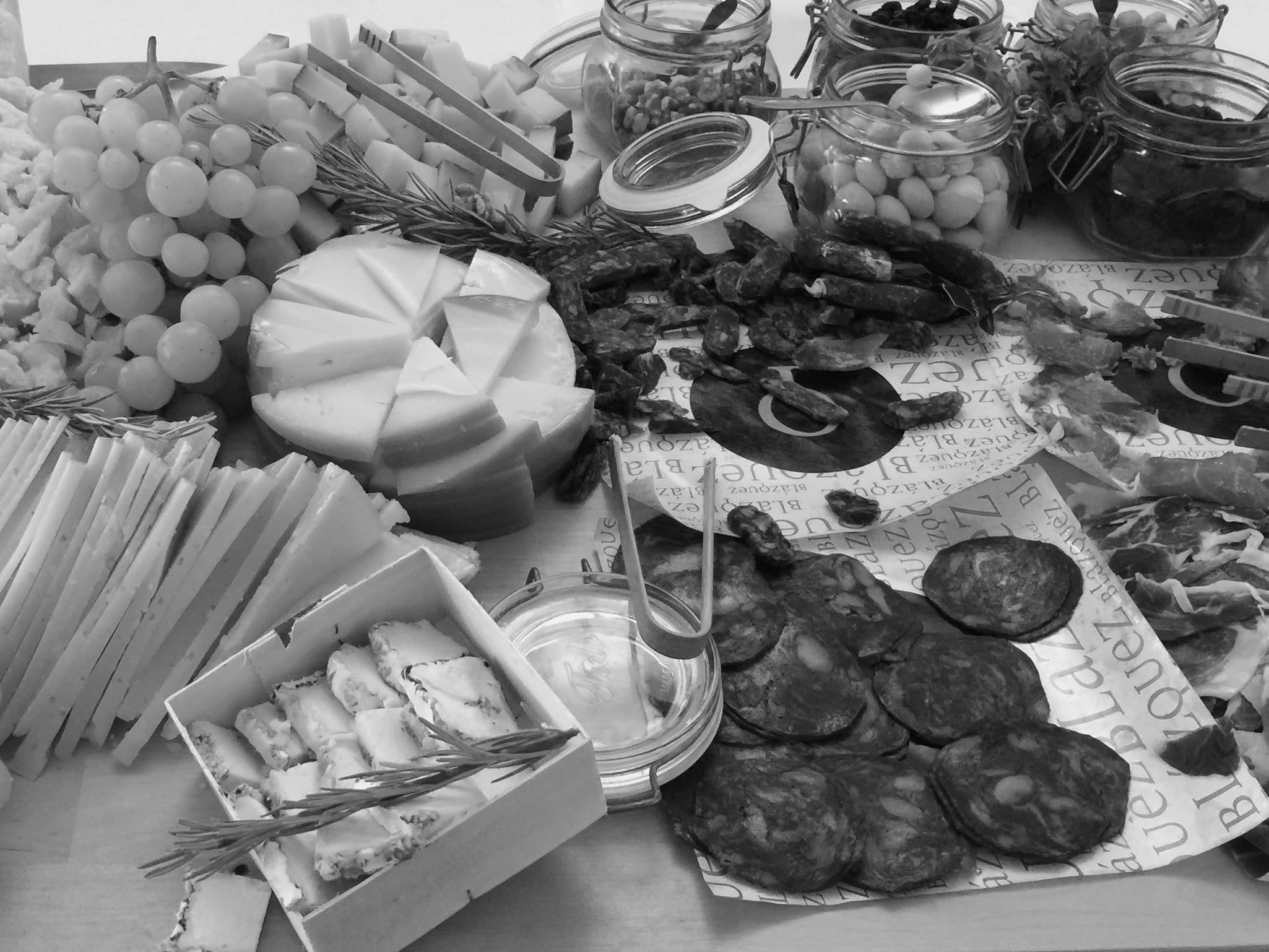
© Michel Heitzmann - Living in slices
I was sitting on the porch with people I will not incriminate. Somebody came up with a saucisson to help the wine go down. Apologies to the V crowd. The saucisson had been a breathing being at some point. Several, actually. More on that another week.
The sharp knife produced thin slices. Small talk continued. I watched the slices.
You cannot eat a saucisson whole. Well, that is almost true. I have seen Poles I know well chewing on their saucissons on ski slopes to avoid the CHF 10 hot dogs. Stay with me, you cannot eat a saucisson whole.
Put the whole thing on a plate and people stare. Slice it thin, fan it out, and within twenty minutes it is gone with the exception of the last slice none dares to touch.
Nobody noticed a meal.
My phone surfaced a Memory last week. Me in a t-shirt I still own. A decade ago, younger and much slimmer. The t-shirt fit and now, lies in a closet, poorly folded and unused. I hopelessly hope to put it back on.
WTF? Can’t wear the thing. It happened to me. One dessert. One skipped walk. One late dinner. A bit of boozing. Bad genes. A slice at a time.
None of it killed me yet.
The algorithm that surfaced the photo did not mean to indict me. It just had the data.
I am now the self-aware victim of my own data and some clever Gen Z in Cupertino.
Before my knee surgeries, I would catch myself saying, to nobody: well, it’s not as bad as yesterday.
That thought was a slice too.
The pain had not gone down. My reference point had slid. Yesterday had reset my reality. I was measuring today against a standard that was already well off and I couldn’t remember.
I was not lying to myself. I was doing what every reasonably intelligent person does when the alternative is expensive, disruptive, scary: saying to myself, it’s OK.
It took CHF 50 thousand, a saw and two new metallic knees to reset the reference point.
Now, the business version.
I watched these campaigns from the inside. Multi-year projects, in rooms few were invited into, to change legislation one comma at a time. If you cannot compete, change the law. One threshold at a time. One exception at a time. The against crowd might be fooled or have too much to lose in a fight.
The goal was never the next comma. The goal was the comma some years later, when somebody looks up and realises the sentence no longer means what it used to mean.
Nobody can point to the moment it changed.
This is not an accident. It is a method. Drawn on whiteboards. Rehearsed in strategy decks. A slice at the time. Executed by polite, perhaps obnoxious, folks who get promoted for executing it well.
I am not going to name names as you know at least one of these folks.
Here is the rule, because by now you figured it.
When you cannot make a brutal change, you slice. Always in the same direction. Each slice small enough that fighting it looks disproportionate. Each loss rationalised by the person losing it. The high-ground disappears because nobody remembers the saucisson, let alone the pig. They just see the slice.
And the asymmetry locks it in. The fear of losing from pushing back is always bigger than the potential of gaining. Every time.
Daniel Kahneman of Princeton fame and his friend Amos Tversky proved this in 1979. They got a Nobel Prize for it. For common mortals, the book is called Thinking, Fast and Slow. I own it. The whole 500 pages. I fall asleep every time I gather strength to open it.
In the rooms I worked in, we did not call it anything. We just used it to sneak our way to progress.
Others have named the slices separately, well. I see them as one thing, and the thing has a name.
It’s NOISE. Noise that hides the big picture.
So why the saucisson on the wooden board.
Because the mechanic is neutral. The knife is neutral. The direction is not.
The t-shirt and the knees, I was on the receiving side. The business slicing, I was holding the knife.
There is another kind of patience, in the opposite direction, that uses exactly the same mechanic. One thin slice at a time. Applied for, instead of against.
Some weeks I add forty lines of code. Some weeks I take photos or answer an email. Some weeks I write a piece like this one and six people write back.
None of the slices look like progress.
The direction does.
Patience on one side. Numbness on the other.
If you have read up to here, you have been a saucisson victim.
Thin slices, laid out on the screen, consumed one by one. You barely noticed because you might have been entertained or kind.
That is how we live the day. And it is alarmingly wrong as we are submerged in noise.
Instead, we should be listening to the birds. At least in my corner of the planet, they only sing a few months out of the year. How lucky I was when I was a child in Brazil. Didn’t know it and had not acknowledged the wonderful soundtracks.
Yes, put aside the noise, let’s hope the saucisson will keep breathing.
What did you agree to that you would not have agreed to had you seen the pig?
I built The Quiet Frame so we can notice the slicing, step back, and reconnect with ourselves, others, and the planet we share with the saucisson (for now). It takes the same thin slice the noise takes — a couple of minutes a day — in the other direction. Free for 7 days on iOS and Android at thequietframe.com/app.
Thanks for reading.
A note on the sources:
The six categories of noise behind this series — cognitive, emotional, identity, performance, relational, algorithmic — are a The Quiet Frame construct. The concepts themselves have long histories. The works I lean on:
Cognitive noise. Sweller, J. (1988). Cognitive load during problem solving: Effects on learning. Cognitive Science, 12(2).
Emotional noise. van der Kolk, B. (2014). The Body Keeps the Score. Viking.
Identity noise. Goffman, E. (1959). The Presentation of Self in Everyday Life. Anchor Books.
Performance noise. Han, B.-C. (2010). The Burnout Society (trans. 2015). Stanford University Press.
Relational noise. Turkle, S. (2011). Alone Together. Basic Books.
Algorithmic noise. Zuboff, S. (2019). The Age of Surveillance Capitalism. PublicAffairs.
The asymmetry. Kahneman, D., & Tversky, A. (1979). Prospect Theory: An Analysis of Decision under Risk.Econometrica, 47(2), 263–291. The popular version is Kahneman’s Thinking, Fast and Slow. I own it. The whole 500 pages. I fall asleep every time I gather strength to open it.
Great piece. And I keep looking for the pigs. I will find them and let them free.